Tuesday, May 29, 2018

Tiedemann Advisors LLC Has $4.15 Million Position in Sempra Energy (SRE)

Tiedemann Advisors LLC boosted its position in shares of Sempra Energy (NYSE:SRE) by 11.9% during the 1st quarter, according to its most recent 13F filing with the Securities and Exchange Commission. The fund owned 36,983 shares of the utilities provider’s stock after purchasing an additional 3,945 shares during the period. Tiedemann Advisors LLC’s holdings in Sempra Energy were worth $4,145,000 as of its most recent SEC filing.

Other large investors have also recently modified their holdings of the company. BlackRock Inc. grew its holdings in Sempra Energy by 2.4% during the 4th quarter. BlackRock Inc. now owns 20,631,499 shares of the utilities provider’s stock valued at $2,205,919,000 after purchasing an additional 475,879 shares during the last quarter. State of Tennessee Treasury Department grew its holdings in Sempra Energy by 7.0% during the 4th quarter. State of Tennessee Treasury Department now owns 99,952 shares of the utilities provider’s stock valued at $10,687,000 after purchasing an additional 6,531 shares during the last quarter. Geode Capital Management LLC grew its holdings in Sempra Energy by 3.3% during the 4th quarter. Geode Capital Management LLC now owns 2,656,308 shares of the utilities provider’s stock valued at $283,424,000 after purchasing an additional 85,865 shares during the last quarter. Dean Capital Investments Management LLC bought a new position in Sempra Energy during the 4th quarter valued at about $948,000. Finally, Sequoia Wealth Management LLC bought a new position in Sempra Energy during the 4th quarter valued at about $200,000. Institutional investors own 90.15% of the company’s stock.

Get Sempra Energy alerts:

In other news, Chairman Debra L. Reed sold 49,909 shares of the company’s stock in a transaction that occurred on Thursday, April 5th. The shares were sold at an average price of $110.37, for a total value of $5,508,456.33. Following the completion of the sale, the chairman now owns 177,227 shares of the company’s stock, valued at approximately $19,560,543.99. The sale was disclosed in a filing with the Securities & Exchange Commission, which is available through the SEC website. Also, Director William G. Ouchi sold 1,918 shares of the company’s stock in a transaction that occurred on Wednesday, May 9th. The stock was sold at an average price of $104.80, for a total transaction of $201,006.40. Following the completion of the sale, the director now directly owns 14,954 shares of the company’s stock, valued at approximately $1,567,179.20. The disclosure for this sale can be found here. Insiders sold a total of 55,775 shares of company stock valued at $6,142,993 in the last ninety days. Corporate insiders own 0.16% of the company’s stock.

A number of equities analysts have commented on the stock. Argus upgraded shares of Sempra Energy from a “hold” rating to a “buy” rating and set a $119.00 target price on the stock in a research note on Monday, May 21st. ValuEngine downgraded shares of Sempra Energy from a “hold” rating to a “sell” rating in a research note on Friday, May 18th. TheStreet upgraded shares of Sempra Energy from a “c+” rating to a “b” rating in a research note on Monday, May 7th. Zacks Investment Research upgraded shares of Sempra Energy from a “hold” rating to a “buy” rating and set a $123.00 target price on the stock in a research note on Tuesday, April 3rd. Finally, Bank of America dropped their target price on shares of Sempra Energy from $116.00 to $113.00 and set a “neutral” rating on the stock in a research note on Tuesday, May 8th. One equities research analyst has rated the stock with a sell rating, four have issued a hold rating and nine have assigned a buy rating to the company. Sempra Energy has an average rating of “Buy” and a consensus price target of $120.64.

Shares of Sempra Energy opened at $105.19 on Monday, Marketbeat Ratings reports. The company has a debt-to-equity ratio of 1.26, a quick ratio of 0.34 and a current ratio of 0.37. The stock has a market capitalization of $27.78 billion, a price-to-earnings ratio of 19.41, a P/E/G ratio of 2.17 and a beta of 0.48. Sempra Energy has a one year low of $100.63 and a one year high of $122.97.

Sempra Energy (NYSE:SRE) last announced its quarterly earnings results on Monday, May 7th. The utilities provider reported $1.43 earnings per share for the quarter, missing the consensus estimate of $1.62 by ($0.19). Sempra Energy had a return on equity of 8.30% and a net margin of 1.45%. The business had revenue of $2.96 billion during the quarter, compared to analysts’ expectations of $3.28 billion. During the same period in the previous year, the company posted $1.74 EPS. Sempra Energy’s revenue for the quarter was down 2.3% on a year-over-year basis. equities analysts forecast that Sempra Energy will post 5.48 EPS for the current fiscal year.

Sempra Energy Profile

Sempra Energy, together with its subsidiaries, invests in, develops, and operates energy infrastructure, as well as provides electric and gas services in the United States and internationally. The company's San Diego Gas & Electric Company segment engages in the generation, transmission, and distribution of electricity.


Institutional Ownership by Quarter for Sempra Energy (NYSE:SRE)

Sunday, May 27, 2018

Has Shopify Met Its Match With Adobe-Magento?

Shares of Shopify (NYSE:SHOP) slipped 4% on May 22 after�cloud-services giant Adobe (NASDAQ:ADBE) agreed to buy its competitor Magento for $1.68 billion. Like Shopify, Magento is a "one-stop shop" that helps merchants digitize their businesses with websites, ads, payment services, analytics, logistics, and customer relationship-management channels.

Magento controlled 16% of the fragmented web-store market last year, according to a study by�Magento industry partner Aheadworks. Shopify controlled 13% of the market, while industry leader WooCommerce held 18%. Other notable competitors included�Oracle's ATG Commerce platform, which controlled 16% of the market, Demandware, which held 10%, and IBM's WebSphere, which held 7%.

A businessman holds a tablet, and hovering above it an illustration of a shopping cart pointing to a truck pointing to a person.

Image source: Getty Images.

The bears clearly believe that Adobe's takeover of Magento could significantly hurt Shopify and its other rivals. But are investors overreacting to the news? Let's dig deeper into this deal to find out.

Why Adobe bought Magento

Over the past few years, Adobe pivoted away from its core software products and diversified into the cloud-services market. It turned its flagship Photoshop software into a cloud-based service within its Creative Cloud and expanded its Experience Cloud, which focuses on enterprise software.

To build that business, Adobe acquired online marketing and analytics firm Omniture in 2009 to expand its digital advertising services. It subsequently bought video advertising platform Auditude for�$120 million, online search and social ad campaign management platform Efficient Frontier Technology for�undisclosed terms, and ad tech firm TubeMogul for�$540 million.

Adobe can now bundle many of those services into Magento for its Experience Cloud customers. This could be bad news for Shopify, Oracle, and even Salesforce -- which competes against Adobe's Marketing Cloud in�the cloud CRM (customer relationship management) market. Morgan Stanley analyst William Blair recently called the�Adobe-Magento combination a "new long-term threat" to Shopify's growth.

Adobe's Digital Experience revenue rose 16% annually and accounted for 27% of its top line last quarter. However, that growth rate was slower than its core digital media segment's 28% growth, which was�supported by its Creative Cloud products. The Magento acquisition could alter that balance in the near future.

Should Shopify investors worry?

Shopify has consistently posted high double-digit sales growth ever since its IPO in 2015. Its revenue rose 68% annually, to $214.3 million last�quarter -- supported by 61% growth in subscriptions revenue, 75% growth in Merchant Solutions revenue, and a 64% jump in its gross merchandise volume (GMV), to $8 billion.

The company also reported robust growth at Shopify Capital, Shopify Shipping, and its premium package Shopify Plus -- indicating that it's successfully cross-selling products to its existing customers and expanding its ecosystem. Wall Street expects Shopify to post 51% sales growth for�the full year.

A shopping cart filled with boxes on a laptop keyboard.

Image source: Getty Images.

However, Shopify only is profitable on a non-GAAP basis, which excludes stock-based compensation expenses and other one-time charges. On a GAAP basis, it reported a net loss of $15.9 million last quarter, which was wider that its loss of $13.6 million in the year-ago quarter.

Its cash and equivalents position grew from $938 million at the end of 2017 to $1.58 billion, but most of that gain (over $500 million) was attributed to its offering of Class A subordinate voting shares during the first quarter.

Simply put, Shopify isn't well-equipped to engage Adobe in a prolonged pricing war. However, Shopify weathered a similar threat before, when Amazon (NASDAQ:AMZN) launched its own�"Webstore" service in 2010 to challenge Shopify. Amazon eventually killed the service in 2015 and integrated Shopify's features into its marketplace instead.

Investors also should recall that eBay (NASDAQ:EBAY) sold�Magento, along with the rest of its enterprise unit, to a group of investment firms in 2015 at a steep loss. That sale indicates that Adobe could also struggle to integrate Magento into the rest of its cloud ecosystem.

The key takeaway

I like Shopify's business and think it still has great long-term growth potential. I'm not particularly worried about Adobe-Magento, since Shopify already faces tough competitors like Oracle and WooCommerce, but I'm concerned about its valuation.

Shopify trades at nearly 15 times this year's sales. Granted, Shopify is a high-growth company, but that lofty valuation makes it an easy target for short-sellers during news-driven sell-offs. Therefore, I'd steer clear of Shopify until its valuations cool down.

Saturday, May 26, 2018

Why Target��s Earnings Were Better Than Advertised

Target�(NYSE:TGT) stock seemed to be finally turning a corner. After years of pressure from e-commerce giant Amazon and Walmart's digital reinvention, shares were significantly trailing the greater S&P 500 and posting a 5-year loss. Over the last year, however,�shares have rallied in response to management's plans to reinvigorate the brand's shopping experience and improve its online shopping channel.�

Unfortunately, the company's first-quarter earnings put a halt to that rally. Target had a mixed report, outperforming on the top line with $16.8 billion in revenue�but missing on the bottom line with adjusted earnings per share of $1.32 versus the analyst consensus of $1.39. Looking beyond the headline numbers, there are signs of improvement: Same-store sales increased by 3% during the quarter, and digital sales increased 28%, a higher clip than the 21% growth rate in the year-ago period.

Still, shares are down 6% this week. Is this a good time for value investors to establish a position?

Family shopping for school supplies.

Image Source: Getty Images

Margin erosion is real, and digital is a factor

Investors' largest concern was Target's margin erosion and its effects on profitability. Although Target's 29.8% gross margin was similar to the prior-year's 30% figure, down-line operating expenses like salaries and benefits increased more than expected, dragging operating margin down nearly a full percentage point -- from 7.1% last year to 6.2%. A certain amount of margin erosion was expected: In November the company raised starting salaries to better compete with Walmart, but the figure was higher than Wall Street's expectations.

While Target's digital growth should be welcomed, it also comes at a cost: reduced profitability. Management noted investments in digital operations and fulfillment and sales mix as contributors to the 90-basis point operating margin decline. The trade-off is that digital growth was a large factor in sales and traffic increases: The former increased 3.7% last quarter, the highest rate in a decade. Investors should continue to monitor how effectively Target balances digital growth with margin preservation, especially in light of higher labor costs.

Target's sell-off seems overdone

Margin concerns aside, the company outperformed on the top line, and it appears the company's $7 billion in investments are finally powering a turnaround. Even more encouraging is the 3.7% traffic increase with narrower gross-margin compression, which means Target's expense inflation is mostly labor-cost related and more easily managed by the company than product or third-party costs would be.

Target remains cheap by traditional metrics, even after its recent appreciation. Shares currently trade at a forward-earnings basis of 13.5x. Shares also yield 3.5%. Although first-quarter earnings underperformed, management reaffirmed full-year guidance, which is encouraging considering its operating margin headwinds.

The death of retail has been exaggerated. Larger operators like Target will continue to exist and thrive, provided they can improve their digital channels and provide seamless shopping experiences.

Friday, May 25, 2018

Chipotle: Corporate Disruption

Only a few months ago, Chipotle Mexican Grill (CMG) announced that Brian Niccol would take over as the new CEO from the co-founder. The stock has surged on this news rising $100 now, but my investment thesis has maintained that investors need to dump shares on this rally as the most likely outcome is disruption of the business model and cultural change from the hiring of an exec from Taco Bell that was at odds with the people at Chipotle. Today, the new CEO fired the first warning sign on this disruptive period.

Source: visitnewportbeach.com

Moving Headquarters

The restaurant chain announced the intention to move the headquarters from Denver to Newport Beach, CA. The move goes as far as to close the corporate offices in Colorado where Chipotle was founded 25 years ago. A costly move considering the company recently signed a 15-year lease at a new skyscraper in downtown Denver covering 5 floors.

The company plans to shut operations in New York and consolidate back-office operations into a Columbus office. Employees at that location will grow from 100 to 250.

The company had the following to say about the move but seemed to skip one key point that employees will quickly figure out.

We have a tremendous opportunity at Chipotle to shape the future of our organization and drive growth through our new strategy. In order to align the structure around our strategic priorities, we are transforming our culture and building world-class teams to revitalize the brand and enable our long-term success...The consolidation of offices and the move to California will help us drive sustainable growth while continuing to position us well in the competition for top talent.

In essence, new CEO Brian Niccol claims that top talent exists in the Los Angeles area, but he makes the same statement regarding access to talent in Columbus. The point not mentioned and quickly outlined by Business Insider is that the new headquarter location in Newport Beach is only about 10 miles from his previous job in Irvine at Taco Bell.

Existing employees will no doubt realize the move is to accommodate the new CEO not wanting to move his family and a decision to possibly poach more employees from Taco Bell on top of CMO Chris Brandt. Low employee moral or inexperienced employees isn't an ideal solution for turning around the brand. Difficult to serve the "food with integrity" concept while the corporate office just laid off most of the employees so the new CEO didn't have to move.

The CEO hire ironically continues to have an eery mirror with the Ron Johnson debacle at J.C. Penny (JCP). Both companies hired an outsider with related industry experience, but at retailers with very different customer bases. The most interesting comparison is that Mr. Johnson didn't want to move to Plano, TX and instead commuted from California. Sound familiar?

Maybe moving headquarters to a new location is more preferable to clashing with existing employees that aren't viewed as "top talent", but paying a premium price for a stock making such as drastic move doesn't seem logical. By the way, the move didn't work out for J.C. Penny as the stock has plunged from over $40 on the excitement of his hiring in early 2012 to a meager $2 now.

New Strategy

Since the health scare, my thesis on Chipotle has constantly hammered home that the company didn't need a new strategy. The Mexican restaurant chain only needed to hammer home the healthy aspects of eating at Chipotle and naturally assure that another major health issue didn't pop up.

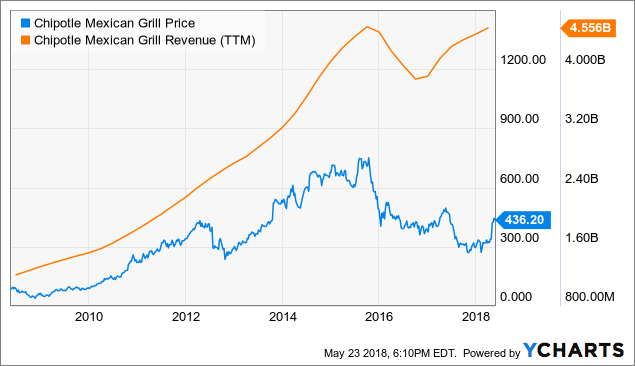
Instead, the company went on an apology tour, changed the process for getting fresh food to stores and lost their message in the shuffle. Anybody looking at the below 10-year chart on revenues and the stock price would likely conclude that Chipotle has top talent. The health scare in late 2015 is starting to look like a blip on the radar.

Chart CMG data by YCharts

The reality remains that Chipotle produced phenomenal results unlikely to be duplicated. The company generated restaurants-level margins in the 27% range prior to the health scare and just about the only restaurant duplicating those numbers now is Shake Shack (SHAK). In Q1, Shake Shack was up at 28.5% while Chipotle was down at 19.5%.

In essence, Chipotle found lighting in a bottle once and it's virtually impossible to repeat. Completely changing the corporate culture and replacing all of those employees that likely include people with deep knowledge of the business isn't a way to achieve these results.

Ron Johnson looked to change J.C. Penny stores into affordable chic similar to his work at Target (TGT) and expound on the high-end work at Apple (AAPL) stores. Customers wanted discounted merchandise and not an upgraded shopping experience.

New CEO Brian Niccol stayed on topic with the "food with integrity" historical concept of Chipotle, but he has routinely talked about innovation, altering the menu, changing the dayparts with a possible shift to breakfast and expanding marketing spend.

All of these moves pull the company away from the actual mission of the company to serve people with quality fresh food via a simple menu. Interestingly, the simple menu and focus is a shared attribute of Shake Shack and the new CEO is moving Chipotle farther away from the one issue that mattered.

No longer does the company discuss obtaining freshly raised food and no longer does the restaurant concept have a cult following.

The company plans a special investor call on June 27 to review the organizational changes. The meeting will have to outline additional costs and factor in disruptions in the business with the end impact being lowered EPS targets. A whole new corporate workforce must be hired to implement these new initiatives.

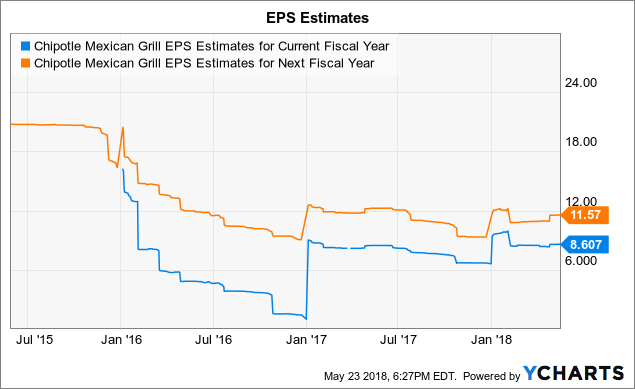
The below EPS targets will no doubt collapse. The company will be lucky hit $10 per share in 2019 making the stock extremely expensive at $435.

Chart CMG EPS Estimates for Current Fiscal Year data by YCharts
With only 28 million shares outstanding, a few million dollars of additional expenses will have a huge hit on EPS. The company is making a shifty move to reduce the costs of being in Newport Beach by moving 150 jobs to low cost Columbus. Off course, the ideal solution was moving employees to Columbus from high costs areas like New York and Denver to cut costs versus shutting complete locations.

The involved cities have the following cost of living scores per Expatistan:

New York City - 241 Los Angeles - 192 Denver - 169 Columbus - 129 Takeaway

The key investor takeaway is that new CEO Brian Niccol wants to implement a new strategy, but most of 2018 will involve shifting office locations and hiring new employees at a high cost to business. Any business model can't possibly accurately estimate the impact to customers and employee morale including store employees not impacted by the shift. What one can derive is that any costly disruption is not good for a stock in the short run and hence a stock like Chipotle must be avoided trading at over 40x reasonable 2019 EPS estimates below $10.

Disclosure: I am/we are long AAPL.

I wrote this article myself, and it expresses my own opinions. I am not receiving compensation for it (other than from Seeking Alpha). I have no business relationship with any company whose stock is mentioned in this article.

Additional disclosure: The information contained herein is for informational purposes only. Nothing in this article should be taken as a solicitation to purchase or sell securities. Before buying or selling any stock you should do your own research and reach your own conclusion or consult a financial advisor. Investing includes risks, including loss of principal.

Saturday, May 19, 2018

PayPal Stock Pops on iZettle Merger News

Paypal Holdings Inc (NASDAQ:PYPL) stock got a boost on Friday from news that it is acquiring iZettle.

PayPal Stock Pops on iZettle Merger NewsSource: Shutterstock

The deal will have Paypal paying a total of $2.20 billion for small business commerce platform iZettle. This will provide the company with an in-store presence across several markets. They include  Brazil, Denmark, Finland, France, Germany, Italy, Mexico, Netherlands, Norway, Spain and Sweden.

Paypal notes that the acquisition of iZettle will also allow it to further expand its abilities in markets it is already present in. It will also help develop omnichannel commerce solutions for PYPL in the U.S., UK and Australia.

Paypal says that it is expecting the acquisition of iZettle to close during the third quarter of 2018. Once this acquisition is complete, iZettle CEO Jacob de Geer will continue to lead the company. He will report directly to PYPL COO Bill Ready.

According to Paypal, the acquisition of iZettle will have a slight negative impact of one penny on its earnings per share for the full year of 2018. The company says iZettle is expecting to see gross revenue of $165 million during 2018.

“In today’s digital world, consumers want to be able to buy when, where and how they want,” PayPal President and CEO Dan Schulman said in a statement. “With nearly half a million merchants on their platform, Jacob de Geer and his team add best-in-class capabilities and talent that will expand PayPal’s market opportunity to be a global one-stop solution for omnichannel commerce.”

PYPL stock was up 2% as of Friday afternoon.

As of this writing, William White did not hold a position in any of the aforementioned securities.

Compare Brokers